News Channel Program — UML Use Case Modeling
Functional Scope for a Prime-Time News Program
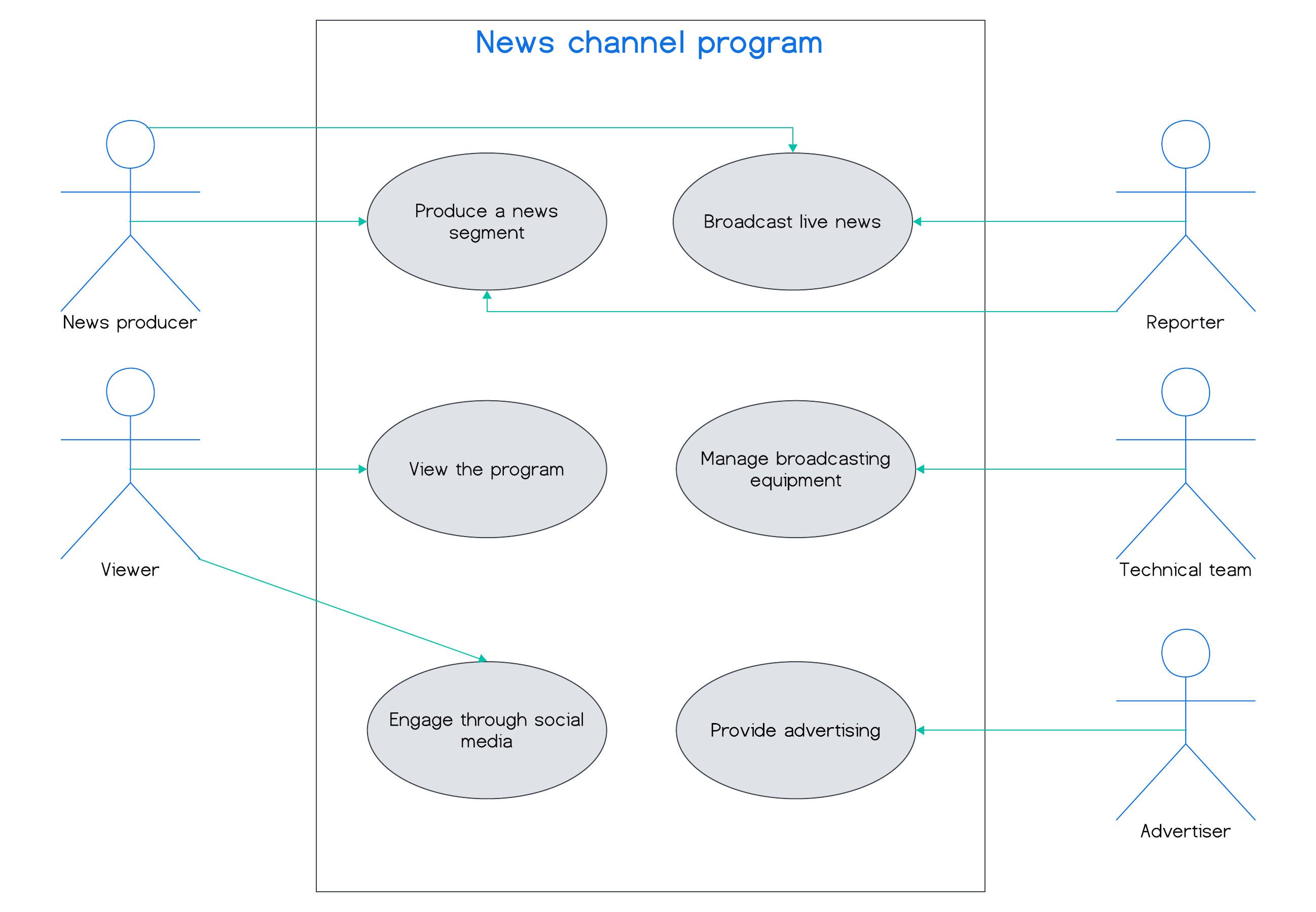
Defined the functional scope of a prime-time news program by identifying five actors, six use cases and their relationships in a UML use case diagram.
Business context and system scope
The modeled system is News Channel Program. Its high-level scope covers preparation and delivery of news content, the live broadcast, audience interaction, broadcast equipment support and advertisement placement.
Actors and participation
| Actor | Role in the modeled system |
|---|---|
| News producer | Plans segments, selects topics, assigns reporters and coordinates live coverage. |
| Reporter | Gathers information, conducts interviews, contributes stories and reports live. |
| Viewer | Watches the broadcast and shares comments or feedback through social media. |
| Technical team | Sets up, maintains and troubleshoots broadcast equipment. |
| Advertiser | Submits advertisements and coordinates their placement with the channel. |
Use cases
| Use case | Purpose |
|---|---|
| Create news segment | Select a topic, gather material and assign a reporter to prepare a segment. |
| Report news live | Deliver news, interviews and updates on air. |
| View program | Watch the live news broadcast. |
| Interact via social media | Comment on stories, share feedback or participate in a discussion. |
| Manage broadcast equipment | Prepare and check cameras, microphones and broadcast software; resolve faults. |
| Provide advertisement | Submit an advertisement and coordinate when it will air during a commercial break. |
UML use case diagram
Modeling approach
- Defined the system boundary before identifying the actors and use cases.
- Separated participants from the functions they interact with.
- Documented the eight actor-to-use-case associations to clarify participation.
- Kept the model at a high level rather than introducing detailed workflows or technical architecture.
The diagram uses actor associations only. It does not introduce include or extend relationships because the exercise does not define use cases that require them.
What this model supports
Use case modeling makes the system scope and participant interactions visible before more detailed requirements are gathered. It provides a starting point for clarifying functional requirements across editorial, technical, audience and commercial activities.
This is an illustrative learning exercise for a high-level prime-time news program, not a specification of a particular broadcaster's production system. Detailed schedules, approval rules, permissions, integrations and non-functional requirements are outside the model's scope.