QuickService Delivery — Process Mapping
Food and Grocery Order Management Workflow
Mapped the order journey for a fictional food and grocery delivery service, from customer order placement to pickup or confirmed home delivery, clarifying responsibilities and process controls.
Business context and process scope
The process starts when a customer submits an order and provides the required details. It ends when the customer collects the order or receipt of the home delivery is confirmed.
Participants: Customer, Customer Service, Sales, Production and Warehouse.
Process stages and responsibilities
| Stage | Responsible area | Main activities | Decision / control |
|---|---|---|---|
| 1. Order placement | Customer Service | Record customer details, requested items and quantities, special instructions and fulfillment preference. | Is the order complete? |
| 2. Payment process | Sales | Provide payment options, verify receipt, update payment status and notify the customer. | Has payment been received? |
| 3. Order preparation | Production | Prepare the order and check accuracy, completeness and readiness. | Is the order ready? |
| 4. Fulfillment | Warehouse | Prepare the order for pickup or dispatch home delivery; notify the customer and confirm handover. | Pickup or home delivery? |
Process model
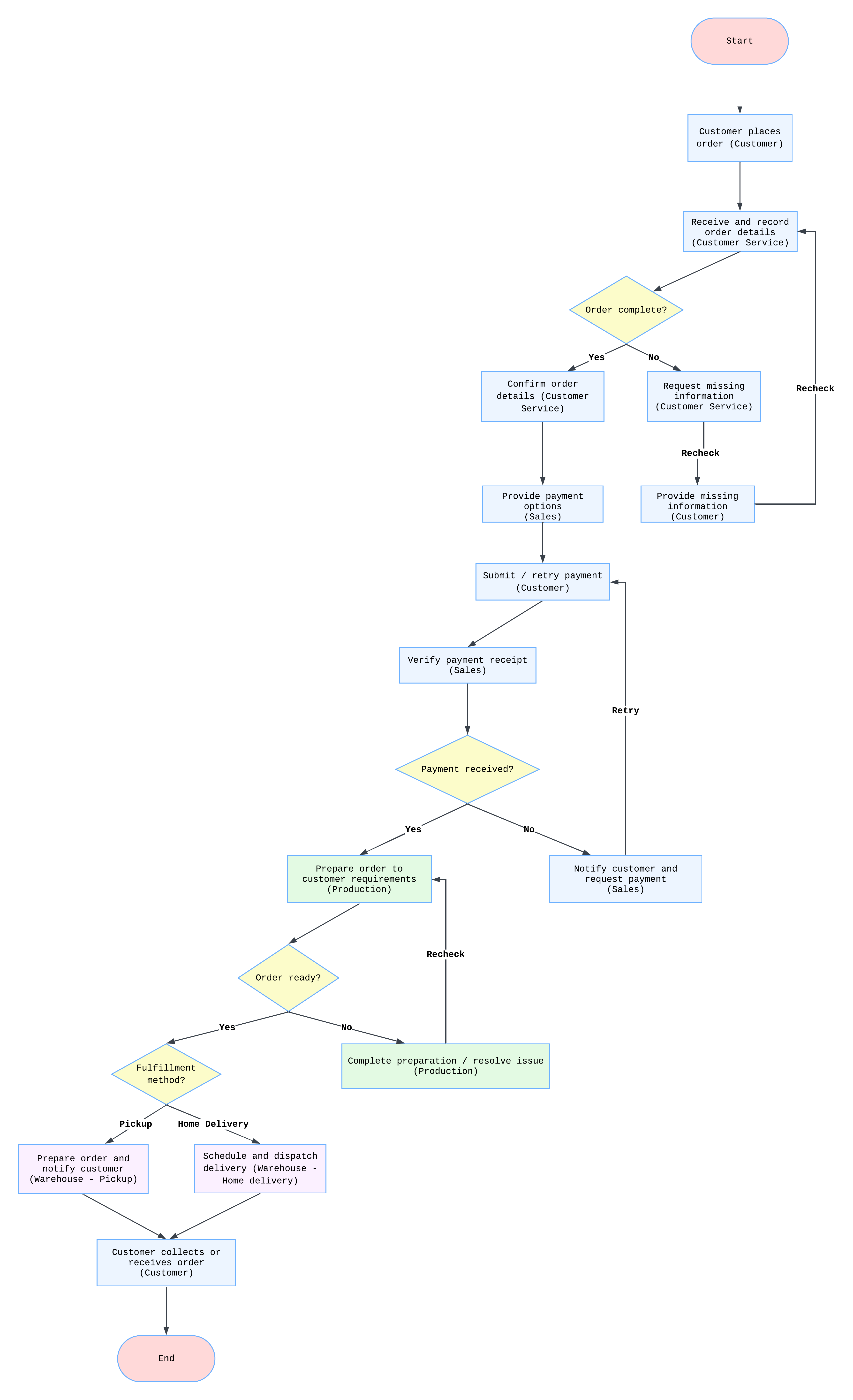
Analysis and decision logic
- Order completeness: Customer Service requests missing information and validates the order again.
- Payment receipt: Sales follows up with the customer and verifies payment again after submission or retry.
- Order readiness: Production completes preparation or resolves the issue before checking readiness again.
- Fulfillment method: Warehouse follows the customer's pickup or home-delivery preference.
What the model makes visible
- Handoffs and responsibilities across five participants.
- Control points that determine whether an order can advance.
- Alternative fulfillment paths for pickup and home delivery.
- Exception paths for incomplete information, payment follow-up and preparation issues.
The exception paths are explicit modeling assumptions. The course scenario does not define a payment cancellation policy or detailed exception-handling rules, so the model uses follow-up and rechecking rather than assuming an unsupported cancellation outcome.
Tools and techniques
Lucidchart · Flowchart notation · Process analysis · Handoff and decision-point identification · Exception-path modeling